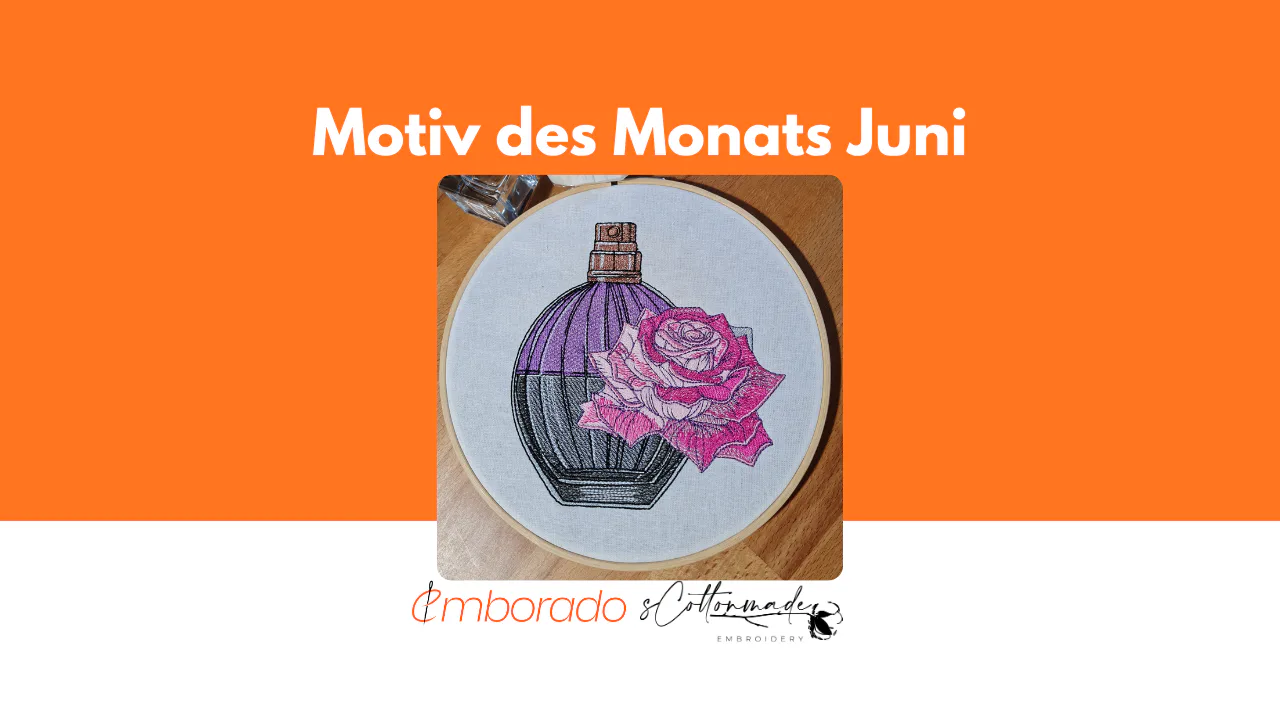
How to Stitch: sCottonmade's Beginner E-Book on Machine Embroidery
Simone from sCottonmade has written an e-book for embroidery beginners. “How to Stitch” covers machines, stabilizers, hooping and thread tension.
Your first embroidery machine is on the table, and suddenly everything is full of new terms: tear-away, bobbin tension, jump stitch, floating. That’s exactly the moment Simone Schölzel from sCottonmade wrote her e-book for: “How to Stitch”, a guide to everything you really need to know as a beginner.
Many of you already know Simone as a designer in the emborado marketplace. In her e-book, she shares over 80 pages of the knowledge she wishes she’d had when she started. We took a look inside and show you what to expect.
Please note: the e-book is written in German.
Contents
- What is “How to Stitch” about?
- A look inside the chapters
- How to spot a good embroidery file
- Staying organised from day one
- Reader perks inside the e-book
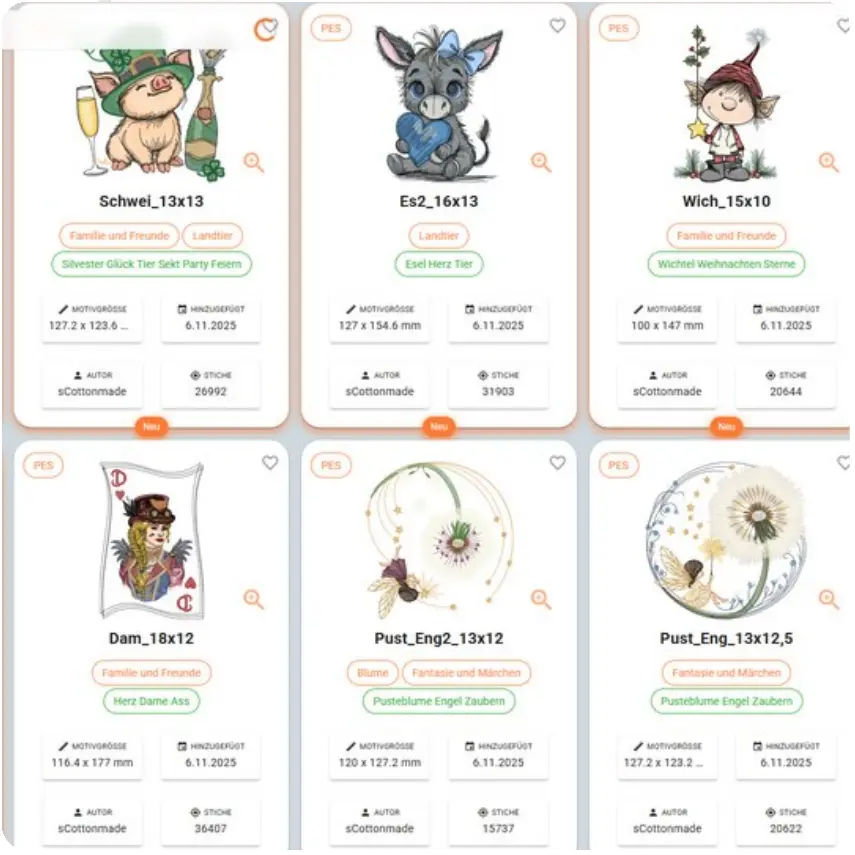
- sCottonmade designs on emborado
- Who is the e-book for?
What is “How to Stitch” about?
Simone found her way to embroidery by chance. Her daughter wished for a sewing machine that soon ended up unused in a corner. Simone tried it out, started sewing, then embroidering, and eventually began digitizing her own embroidery designs.
You can feel that journey in the e-book. It isn’t a dry manual but a personal guide with plenty of practical tips, photos and examples. Simone’s core idea: machine embroidery isn’t rocket science, but it needs a solid foundation.
A look inside the chapters
The e-book is structured so you can read it front to back without any prior knowledge. A few topics stood out to us.
Embroidery machines and buying advice
Simone explains the differences between single-needle and multi-needle embroidery machines, combination machines and industrial machines. She adds buying advice with clear criteria such as hoop size, display and LED pointer. Her advice: the best machine is the one that suits you. Not necessarily the most expensive, but not the cheapest either.
Terms, accessories, threads and needles
A dedicated chapter explains the key terms, from appliqué and FSL to in-the-hoop and jump stitches. For accessories, Simone clearly separates what you really need to get started from what becomes useful later. There’s also an overview of thread types and a table showing which needle size suits which fabric.
Stabilizer, the invisible hero
Simone says she gets asked almost daily whether stabilizer can simply be left out. Her answer is clear. The e-book introduces the four classic types, from tear-away and cut-away to water-soluble and adhesive stabilizers, each with use cases and expert tips.
Especially handy is the rule of thumb for beginners: rigid fabric needs tear-away, stretchy fabric needs cut-away, pile fabric needs a topping, and slippery fabric needs fusible or adhesive stabilizer.
Hooping and thread tension
According to Simone, hooping is still one of the biggest challenges in embroidery. She explains why rectangular hoops distribute tension differently from round ones and why you shouldn’t open the hoop screw too far. In the chapter on thread tension, she uses photos to show how you can tell from the stitch-out whether your upper and bobbin thread are set correctly.
Software, maintenance and troubleshooting
Do you need expensive embroidery software right away as a beginner? Simone’s answer: not to start with. There’s also a chapter on machine care and, at the end, an overview of common problems such as thread breaks, needle breakage and bird nests, each with possible causes and solutions.
How to spot a good embroidery file
One chapter impressed us in particular because many beginner guides skip it: how do you recognise a good embroidery file?
Simone’s key message: an embroidery file isn’t a picture, it’s the technical blueprint for your machine. If that blueprint is flawed, even the best machine and the finest thread won’t help.
Using examples, she shows what to look out for:
- Preview image: real stitch-out photos tell you more than digital mockups.
- Hand-digitized or automatic: auto-conversions ignore fabric and stitch direction.
- Stitch angles and stitch types: they decide whether a design distorts.
- Back side and sequence: a well-planned stitch sequence shows in a tidy back side.
A lovely tip from the chapter: your machine tells you whether a file is well built. If it runs smoothly, the sequence is right. If it sounds hectic and rattles, probably not.
As a practical example, Simone also introduces a designer whose files meet exactly these quality criteria: Joycii-Design. Her files run smoothly, the outlines stay clean, and the stitch sequence is set up so the machine works without unnecessary strain.
Staying organised from day one
Anyone who embroiders regularly soon notices that it’s not just the accessories that grow, but the collection of embroidery files too. Simone dedicates a whole section to this and recommends starting with a clear file management system as early as possible.
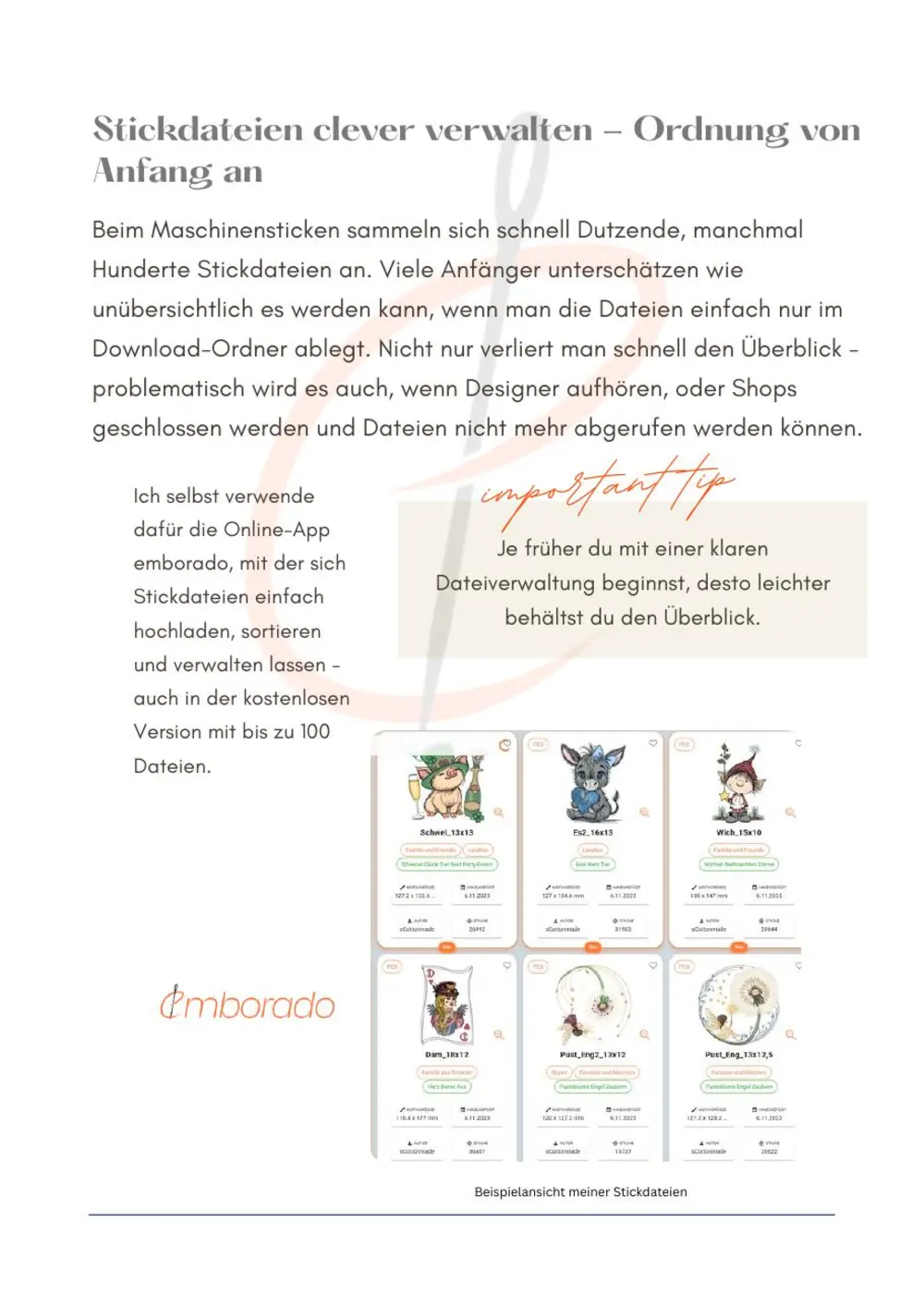
Of course, we were especially happy about this section. Simone uses emborado herself to upload, sort and find her embroidery files. She also points out a risk many people underestimate: when designers stop or shops close, purchased files are often no longer available. Keeping your collection in a safe place protects you from that.
If you’d like to see how this works in practice, our page on managing embroidery designs gives you an overview. A free account is all you need to get started.
Reader perks inside the e-book
Simone has arranged a few extras for her readers. Inside the e-book, you’ll find:
- a voucher for her own shop
- a discount on threads from Smart-Thread, her personal favourite
- a discount on an emborado subscription
The codes are exclusive to the e-book, so the purchase can pay for itself with your very first order. 👉 Get the “How to Stitch” e-book
sCottonmade designs on emborado
What Simone describes in the chapter on good embroidery files is exactly how she works on her own designs. Every size is digitized individually and tested by her test stitchers before it goes online.
In the sCottonmade shop in the emborado marketplace, you’ll find all twelve zodiac signs, individually or as a set:
In the marketplace, you pay with emborado Talers, get every design in all available formats and have the file in your collection straight away. If a design is already there, emborado warns you before you buy.
Find out more about Simone and her designs on her designer page at emborado and at scottonmade.de.
Who is the e-book for?
“How to Stitch” is for anyone just starting out with machine embroidery or about to buy their first embroidery machine. Even if you’ve already stitched a few projects and want to understand why something works or doesn’t, you’ll find plenty of helpful explanations.
Simone’s most important advice at the end: just get started. Pick a simple design, a piece of sturdy cotton and a matching tear-away stabilizer. Every broken thread is part of the learning process.
👉 Get the “How to Stitch” e-book from sCottonmade
👉 Visit the sCottonmade shop in the emborado marketplace
If you want to dive deeper into the basics, take a look at our introduction to machine embroidery.