Starting a textile customization business: how to prepare large embroidery orders
Guest post by Lara Uschakow: Why large embroidery orders depend less on stitching time and more on planning, digitizing, sample approval and clean organization.
In the first part of this blog series, I shared why I decided to invest in an embroidery machine. In the second part, I wrote about my first embroidery mistakes and how much you only really understand once you start working in practice.
In this third part, I want to focus on something that becomes more and more important once tests turn into real customer projects: large embroidery orders.
When people think about a bigger embroidery order, they often think about stitching time first. How long will the machine run? How many pieces can you finish in one day? How quickly can the order be completed?
But I learned very quickly that a successful large order starts much earlier. It does not start when the machine begins stitching. It starts with planning.
Why planning matters so much in embroidery orders
In embroidery, the machine is the most visible part of the process. It is in the room, it moves, and it creates the finished result. Still, in my experience, it is not the only decisive factor.
Especially when quantities get larger, good organization often matters more than production speed alone. If it is not clear from the beginning which design goes on which textile, which sizes are needed, whether there are personalizations or when the order really needs to be finished, problems can appear quickly later on.
That is why every larger order starts with a clear discussion of the key details:
- Which design should be embroidered?
- Which textile should it go on?
- How many pieces are needed?
- Are there different sizes, colors or versions?
- Are there personalizations, such as names or departments?
- When does the order need to be finished?
- Are there special requirements for placement, durability or appearance?
These questions may sound basic at first. But they often decide whether the order can run smoothly or whether new uncertainties keep appearing during production.
The design has to work as embroidery
After the first briefing, I look closely at the design. Not every logo that works well as a print file can be transferred directly into embroidery.
Very small details, fine lines, gradients or tiny text can become difficult in embroidery. That is why I check before digitizing whether the design is suitable as it is or whether individual elements should be adjusted.
This is not about changing a logo unnecessarily. It is about creating a result that actually looks high quality on fabric. A design can look perfect on screen and still be too detailed for embroidery. Being able to judge that is an important part of preparation.
For me, this also means explaining early and transparently to the customer if something needs to be adapted. I would rather clarify those points in the beginning than end up with a sample that is technically stitched, but does not look the way everyone imagined.
Textile, design and availability have to fit together
At the same time, I check which textiles are suitable for the order. A hoodie behaves differently from a thin shirt. A cap has different requirements than workwear. And not every design works equally well on every material.
For larger orders, there is another important point: availability. It is not enough to find a textile that fits the design. It also has to be available in the required quantity, color and size.
So I check early:
- Is the chosen textile suitable for embroidery?
- Are the required sizes and colors available?
- Can the quantity be sourced quickly enough?
- How long will delivery take?
- Should an alternative be planned?
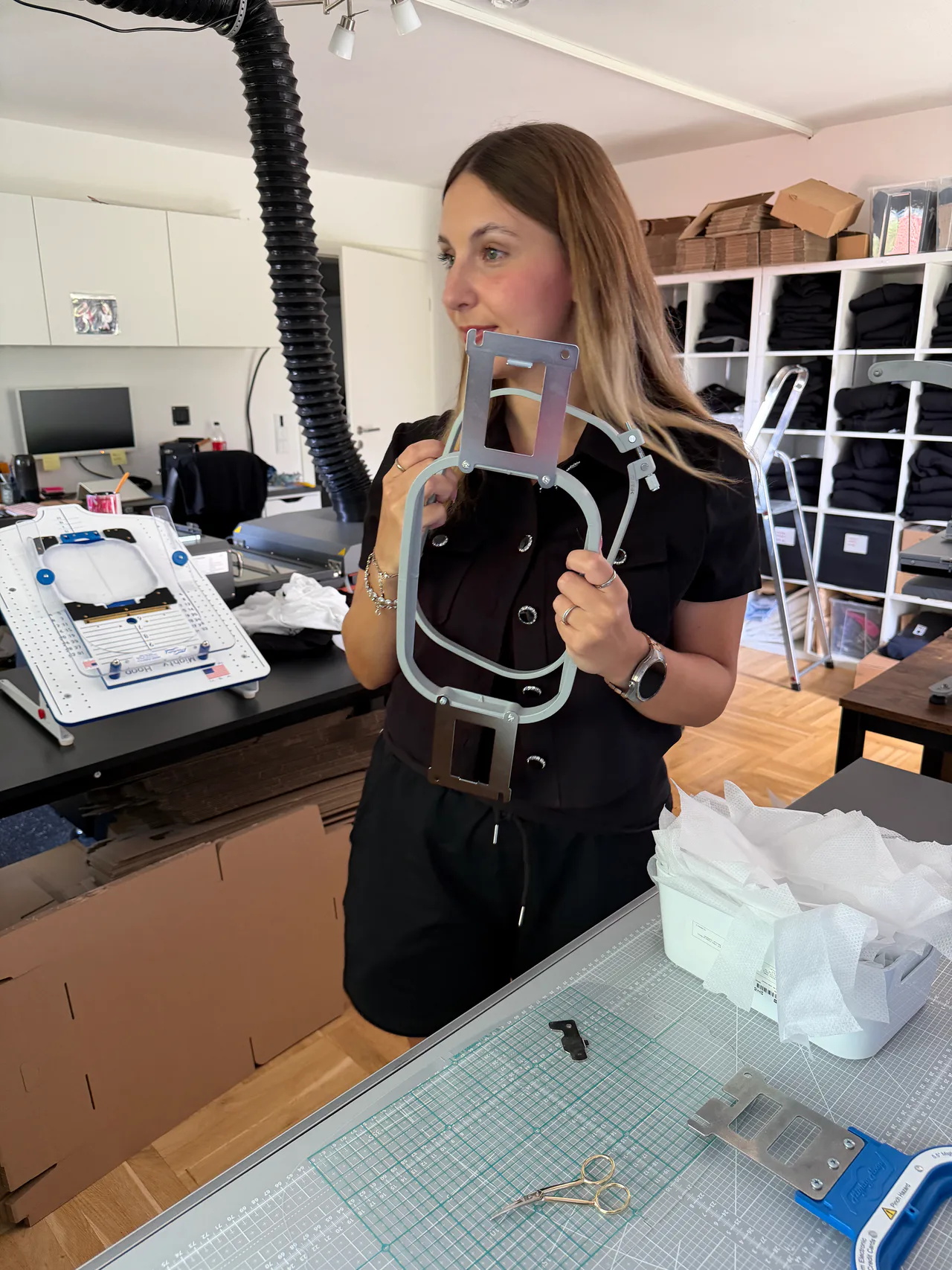
I also always plan a few extra textiles, just in case there is waste. In embroidery, mistakes can happen even when you work carefully. A thread break, a badly hooped piece, a material flaw or a small handling mistake can be enough. Especially with large orders, I do not want to risk ending up one textile short at the end.
Digitizing decides quality and efficiency
One of the most important steps in the whole process is digitizing the embroidery file. It has a major impact on how clean, high quality and efficient the stitching will be later.
Digitizing is not just about turning a logo into some file the machine can read. It is about stitch types, stitch direction, order, density, underlay, outlines and how the design will behave on the specific textile.
With larger quantities, good digitizing becomes even more important. If a file is poorly built, you do not only see the problem on one item. The problem repeats on every textile.
A clean file, on the other hand, can save a lot of time:
- fewer thread breaks
- cleaner outlines
- better embroidery quality
- less distortion
- more efficient stitching time
- more consistent results across the full order
That is why I would rather spend more time preparing the file than having to rework hundreds of textiles later. This has been one of my biggest lessons: in embroidery, you cannot simply produce your way out of problems. You need to understand them before production starts.
No large order starts without sample approval
Before a larger order goes into production, I create a sample. This makes it possible to check the size, placement and final embroidery look together with the customer.
Especially for large orders, sample approval is very important to me. It gives both sides a clear basis. The customer can see what will be produced, and I can be sure that size, placement, colors and overall appearance have been approved.
This helps avoid later changes and misunderstandings. Because once 50, 100 or more textiles have already been embroidered, every correction becomes expensive, time consuming and frustrating.
For me, a sample is not an optional extra step. It is a safety net.
Material planning: thread, stabilizer, needles and supplies
Before production begins, I do not only prepare the goods. I also check whether I have enough thread, stabilizer, needles, bobbin thread and other consumables.
It would be extremely frustrating if an order had to stop in the middle of production just because a thread color runs out or the right stabilizer is missing. That is why I plan these things intentionally.
For larger orders, preparation means:
- checking thread colors and making sure there is enough stock
- preparing the right stabilizer for the material and design
- checking needles and keeping replacements ready
- preparing bobbin thread
- sorting textiles by variant
- keeping the sample, approval and production files easy to access
These steps are not spectacular. But they are exactly the small things that later make the difference between stress and a clean workflow.
Realistic scheduling instead of wishful thinking
When planning time, I try to be realistic on purpose. An embroidery machine runs at a fixed speed. You cannot simply make production much faster because the order is larger or the deadline is getting closer.
And the pure stitching time is not the full production time.
While the machine is running, a lot still happens in the background:
- hooping textiles
- removing finished pieces
- removing stabilizer
- trimming threads
- checking quality
- preparing the next textiles
- accounting for thread changes, thread breaks and bobbin changes
I quickly realized that in embroidery, the machine is not always the limiting factor. Good organization is. When everything is prepared, production can run calmly and consistently. When things constantly need to be found, reordered or decided again, you lose much more time than you would from the actual machine speed.
Communication is part of the process
With larger orders, transparent communication is especially important to me. If something changes or gets delayed during a project, I want to bring it up early.
Clear agreements create trust. That starts with the inquiry, but it also continues during preparation and production. Customers who do not work with embroidery every day often cannot easily estimate how many steps are behind a finished textile.
That is why I would rather explain one time too many why a sample makes sense, why a design should be adjusted or why a certain deadline is realistic or already quite tight.
Why documentation matters more with every order
The larger the orders become, the more important documentation becomes for me. Which file was approved in the end? Which thread colors were used? Which textile, which stabilizer, which placement and which design size worked well?
That information is extremely valuable when a customer reorders later or when a similar project comes in.
This is exactly where emborado fits into my daily work. For me, it is not only about storing embroidery files somewhere. I want to be able to understand which version belongs to which order and which additional information was important.
Especially when several people are involved in the process, a simple and consistent structure becomes important. Then the same information does not have to be searched for again or pieced together from old messages.
My conclusion: preparation is part of production
For me, a successful large order is not the one that is finished as quickly as possible. A successful order is one where every single piece has the same quality in the end.
That requires good preparation: clear agreements, suitable textiles, careful digitizing, sample approval, material planning, realistic scheduling and clear communication.
I would rather invest more time at the beginning than have to rework hundreds of textiles later. Good planning does not only lead to a better result. It also makes the entire production process much calmer.
For founders in textile customization, I think this is an important lesson: growth does not only happen by accepting larger orders. Growth happens when you build processes that can reliably support those orders.
In the next parts of this series, I want to continue showing how individual orders gradually turn into professional workflows and which decisions really matter in the everyday life of a young textile customization business.
About Lara, laricari.studio and Textilstätte
Under the name laricari.studio, I document my journey into self employment and the process of building my textile and merch business. It is not only about textiles, but also about entrepreneurship, everyday life as a self employed person, decisions, lessons, failed attempts and the process of building something of my own step by step.
I offer my services through Textilstätte. Together with my partner, we create custom textile products using DTF printing, embroidery, sublimation and vinyl cutting. We also build fulfillment and shop systems for creators, brands and businesses that want a professional web presence with an online shop. From technical implementation to production, order processing and shipping, we support everything from one source.
Would you like to follow Lara’s journey?
- laricari.studio on Instagram, TikTok and YouTube
- Textilstätte on Instagram and at textilstaette.de
- Inquiries by email at anfragen@textilstaette.de or by phone at 0151 65915434