Video Talk with AKA-TEX: Why Good Embroidery Digitizing Is More Than One Click
What makes a good embroidery file? In our conversation with the Academy for Textile Finishing, we talked about experience, automation, materials and practical training.
Video Talk with AKA-TEX: Why Good Embroidery Digitizing Is More Than One Click
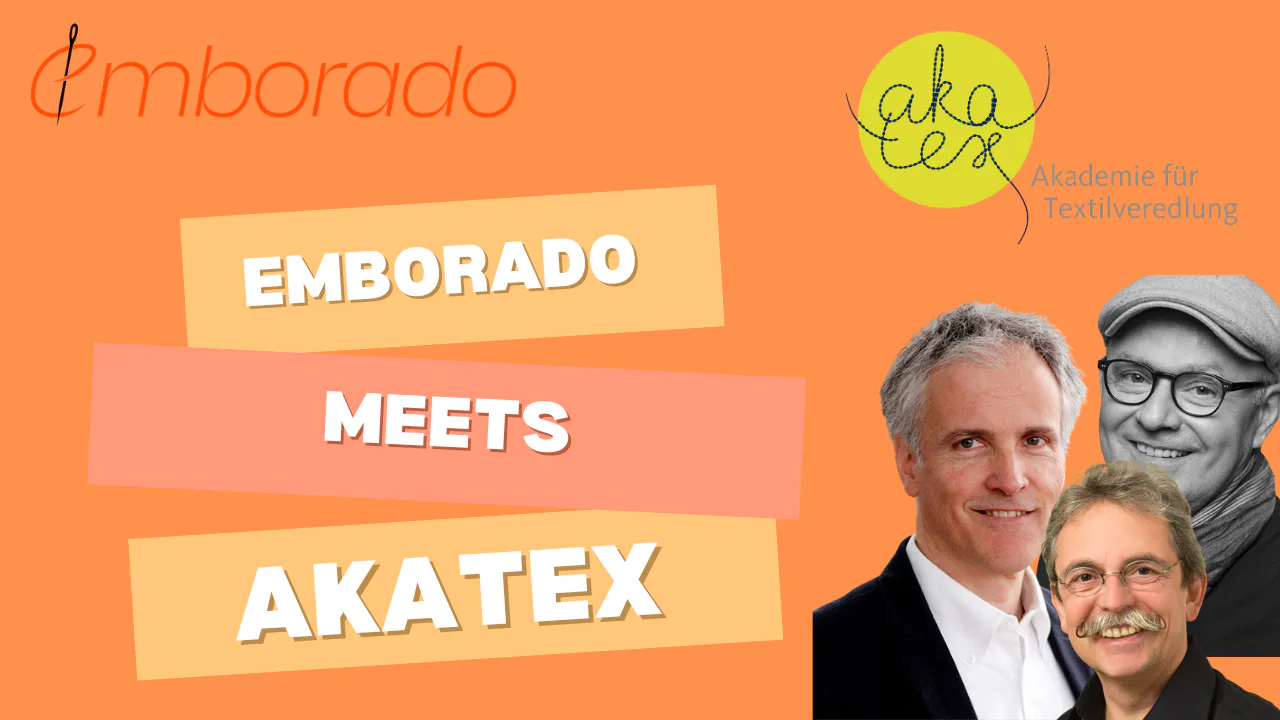
For our video conversation, I spoke with Stefan Roller-Aßfalg, head of the Akademie für Textilveredlung, and seminar leaders Dennis Ermert and Massimo Beizatto. We focused on two questions that come up again and again in embroidery: What makes a good embroidery file? And why is it not enough to simply convert a design into stitches automatically?
You can watch the full conversation on YouTube: Video talk with the Akademie für Textilveredlung.
Training Fills an Important Gap
In the conversation, Stefan Roller-Aßfalg explains why the Academy for Textile Finishing was founded around ten years ago. Traditional training paths in embroidery and textile finishing have become less common, while many people now enter the field through machines, software or existing businesses.
This is exactly where the academy’s seminars come in. They provide fundamentals, practical knowledge and orientation for people working with textile printing, embroidery, finishing or digitizing embroidery files. The focus is not only on software, but on understanding how the machine, thread, needle, stabilizer, fabric and embroidery file work together.
An Embroidery Machine Alone Does Not Create Good Embroidery
One central theme of the talk was the expectation that modern software can do almost everything automatically. Of course, software can recognize artwork, convert vector graphics and generate initial stitch data. But Dennis and Massimo make one thing very clear: automation does not replace expertise.
A good embroidery file is not created only on screen. It has to run well on the machine, suit the material and look clean once stitched. That means thinking in needle and thread. Stitch direction, stitch density, underlay, pull compensation, color changes, trims and the stitchability of small details all matter.
This becomes especially visible with small lettering, fine outlines or highly detailed artwork. A design can look perfect on the screen and still be too dense, too unstable or technically difficult on fabric.
Good Digitizing Is Also About Production
Another interesting part of the conversation was the production perspective. An embroidery file is not only good when it looks nice. It also has to be built in a practical way.
Too many unnecessary stitches, too many color changes or too many thread trims cost time. Dennis points out that removing very small, unnecessary stitches can noticeably reduce production time. Massimo adds that a well-structured embroidery file makes a real difference, especially on smaller machines or when producing larger quantities.
In other words, good digitizing combines design, technology and efficiency. It simplifies where necessary, while keeping the character of the design. It uses the strengths of embroidery instead of trying to recreate a print file stitch by stitch.
Seminars Help People Understand the Craft
The Academy for Textile Finishing distinguishes between beginner and advanced topics. For beginners, the first step is understanding the basics: How do machine, thread, needle and stabilizer interact? What is stitch length? What does stitch density mean? Why does a circle not automatically stitch as a perfect circle? And what is pull compensation?
In more advanced seminars, participants often bring their own questions, machines and software experience. That makes the sessions more practical and individual. Which settings fit a specific fabric? Why do gaps appear? What causes thread breaks? And why does the finished embroidery look different from the original artwork?
This practical perspective is what makes this kind of training valuable. Participants do not only learn which software function exists. They learn when and why to use it.
Knowledge Also Grows Through Exchange
The conversation also showed something beyond the technical side: seminars are places for exchange. Participants learn from each other, form groups, stay in touch and continue helping one another after the seminar.
For an industry where many people work alone or in small businesses, that network can be incredibly valuable. It is about questions such as: How do others organize their thread cones? How do they handle difficult materials? Which mistakes are normal in the beginning? And who can you ask when you get stuck?
That mix of experience, craft and community is what makes the work of the Academy for Textile Finishing so interesting.
If you want to dive deeper, you can find seminars, events and further information directly at the Akademie für Textilveredlung. You can also watch the full conversation as a YouTube video.